Based on His Majesty King Abdullah II’s vision, “Jordan 2025,” which aims to make Jordan a regional gateway in the fields of information and communication technology and e-commerce, and to transform Jordan into an information society equipped with all the capabilities and competencies required to meet the challenges of the global knowledge economy, His Majesty launched the “Educational Development Project Towards a Knowledge Economy” to enhance the level of the educational system in the Kingdom and keep pace with local, regional, and international requirements and needs. All public schools have been computerized and electronically connected, making Jordan an advanced model whose experience in this field has benefited many countries in the Middle East and the Gulf region.
Providing the infrastructure of high-speed fiber optic networks supports the digital transformation by connecting government departments in the governorates with central offices in the capital, as well as integrating different government institutions. This has a significant impact on economic development, enhances the efficiency of e-government services, and creates job opportunities, thereby contributing to increasing the national economy’s value.
Objectives
· Expanding digital infrastructure: Providing advanced fiber optic infrastructure that covers various parts of the Kingdom, contributing to improved quality and speed of internet services.
· Enhancing the digital economy: Enabling different economic sectors to benefit from digital transformation and increasing business and service efficiency through high-speed, stable internet.
· Supporting education and healthcare: Improving educational and healthcare services by connecting them through fiber optic networks, facilitating access to advanced educational and medical resources, and enabling remote services.
· Attracting investments: Drawing global and local companies to invest in Jordan by providing advanced digital infrastructure, which strengthens the business environment and stimulates economic growth.
· Reducing the digital divide: Achieving digital equity by providing high-speed internet services to rural and remote areas, helping integrate all segments of society into the digital economy.
Organization Structure
NBN ORG. Structure
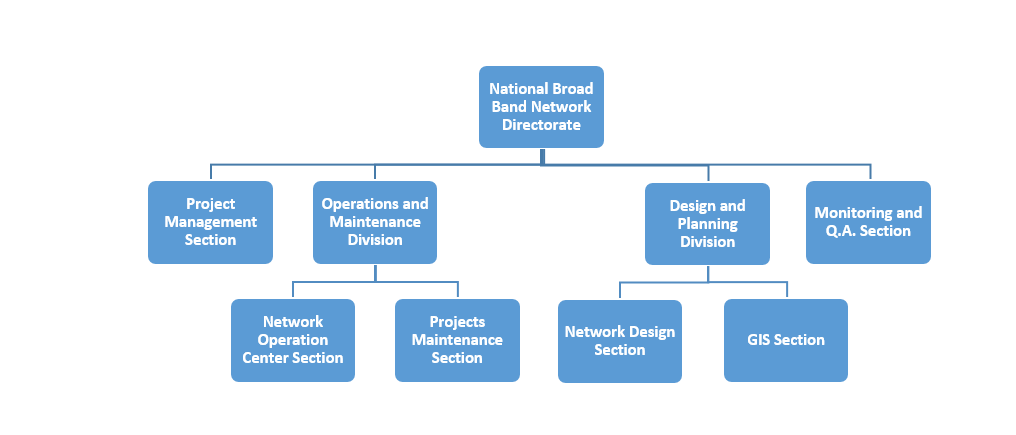
Project Management Department
Responsible for the comprehensive management of all contracts and resources related to contractors and government entities involved in the project. It supervises the progress of all program projects and monitors their implementation, tracks the program’s budget, manages partnership agreements with the private sector, and ensures their sustainability.
Monitoring and Quality Assurance Department
Responsible for monitoring the program’s performance and overseeing the progress of its operations, particularly regarding financial matters, including annual expenditures and revenues. The department also tracks operational processes to ensure compliance with program procedures, aiming for continuous improvement and quality assurance. Additionally, it prepares periodic reports that reflect the program’s performance.
Design and Planning Directorate
- Network Design Department
Responsible for planning and designing the addition of new sites, installation of equipment rooms and devices, or modifications to the existing network. This includes planning and design procedures for infrastructure projects, approving final designs, and setting timelines for implementation according to the allocated budget. The department also manages infrastructure leasing procedures for private companies.
- Geographic Information Department
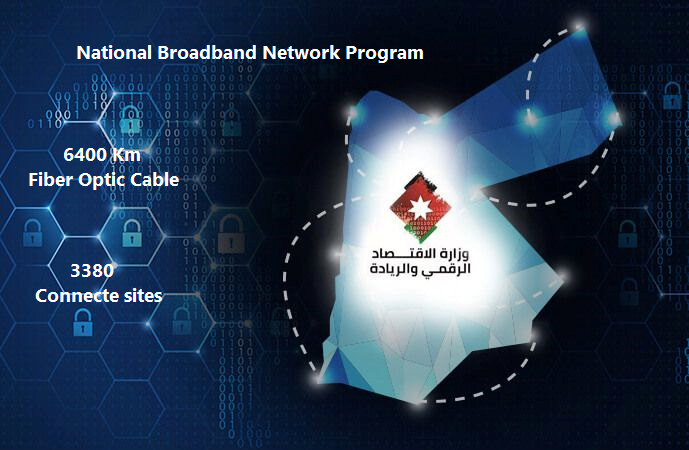
Documents the geographic and descriptive information of the national fiber optic network, covering 6,400 km of fiber optic cables, including strands and internal connections. An interactive platform has been created to support the sustainability of the fiber optic network, accessible at all times. The platform displays all network information and updates in real time, including details of serviced institutions, their geographic locations, the geographic distribution of fiber optic routes, and the quantities of fibers.
Operations and Maintenance Directorate
- Operations Department
Automates NOC (Network Operations Center) services, enabling technicians to check the status of fiber lines at any time and from any location. It allows querying the status of device outputs for ministries, conducting site visits, and providing connectivity solutions for ministries and government agencies. This ensures the benefits of the national fiber network are utilized for connecting branches or providing internet access, reducing high costs for these entities.
- Project Maintenance Department
Ensures service continuity and maintenance of network breaks, expands the network, connects new sites to the existing network, and carries out improvements and transfers of underground and aerial cables. It also handles the removal and dismantling of canceled cables and routes.
Services Provided by the National Fiber Optic Network Program:
- Adding a new site (governmental, health, educational):
Connecting the main or branch sites of ministries and institutions (governmental, health, educational) across all governorates of the Kingdom to provide electronic services and internet access.
- Leasing infrastructure to telecom companies:
Providing fiber strands or ducts for registered Jordanian private companies licensed by the Telecommunications Regulatory Commission in all areas where the National Fiber Optic Network is available, ensuring fast service delivery at the lowest cost.
- Providing communication services to military entities:
Supporting the delivery of services to security and military agencies and their sites in all areas covered by the National Fiber Optic Network by supplying dark fiber strands.
- Agreements with electricity companies:
Agreements between the Ministry of Digital Economy and Entrepreneurship and electricity companies to exchange mutual benefits.
- Maintaining the existing network:
To ensure the sustainability of services for ministries and institutions (governmental, health, educational) connected to the fiber optic network, maintenance of cables and repair of related faults is carried out according to the Service Level Agreement (SLA).
- Ensuring network sustainability through coordination:
Coordinating with all relevant authorities to prevent any damage to the network. Coordination with government entities and institutions responsible for issuing excavation permits to avoid conflicts with the National Fiber Optic Network managed by the Ministry of Digital Economy and Entrepreneurship.
For more information about services, please contact:
Phone: +96265805700
Fax: +96265861059
|
Region
|
Educational Entities
|
Health Entities
|
Government Entities
|
Sum.
|
|
North
|
821
|
111
|
277
|
1209
|
|
Middle
|
658
|
73
|
335
|
1066
|
|
South
|
656
|
110
|
339
|
1105
|
|
Sum.
|
2135
|
294
|
951
|
3380
|
Fiber Optic Network Projects in the Kingdom Fiber Optic Network Projects in the Kingdom
- Southern Region Projects
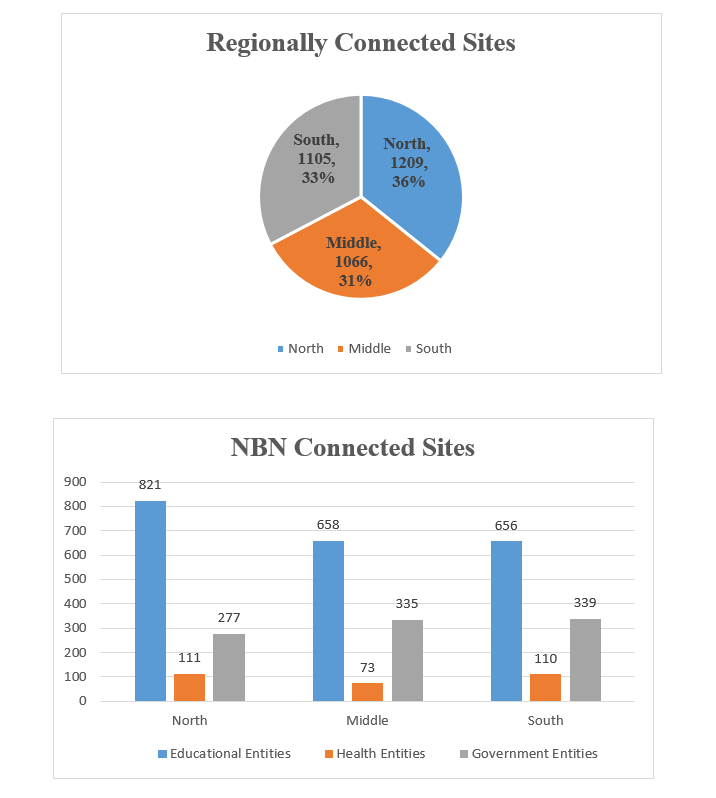
In the Southern Region, 1,105 sites of governmental, health, and educational institutions in the governorates of Karak, Tafila, Ma’an, Southern Jordan Valley, and Aqaba have been connected to the National Fiber Optic Network of the Ministry of Digital Economy and Entrepreneurship, using 2,500 km of aerial and underground cables.
- Northern Region Projects
In the Northern Region, 1,209 sites of governmental, health, and educational institutions in the governorates of Jerash, Ajloun, Irbid, Northern Jordan Valley, Mafraq, and Ramtha have been connected to the National Fiber Optic Network, using 2,050 km of aerial and underground cables.
- Central Region Projects (Funded by the Saudi Development Fund)
Consultancy Services for the Central Region:
Supervision of the civil works and cable projects, as well as the connectivity devices project for the Central Region, has been completed.
Civil Works and Cable Project for the Central Region:
658 sites of governmental, health, and educational institutions in the governorates of Zarqa & East Amman, Balqa & West Amman, and Madaba & South Amman have been connected to the National Fiber Optic Network, using 1,360 km of cables, including 685 km underground.